Showing posts with label Sri Lanka. Show all posts

Friday, July 11, 2014

Colombo to Taipei...

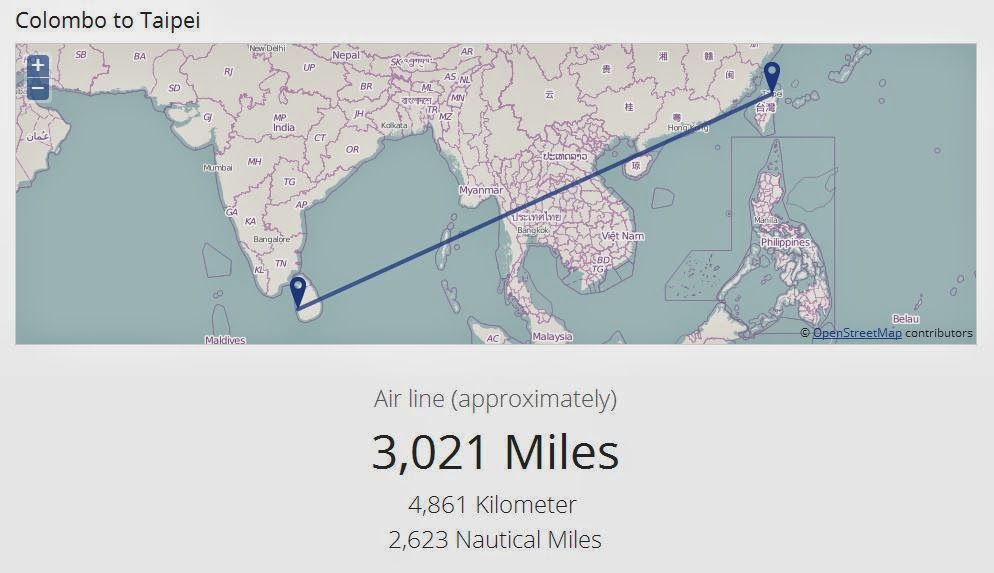
I just wanted to see the distance from Colombo to Taipei, the two capital cities of Sri Lanka and Taiwan respectively. I'm originally from Sri Lanka now in Taiwan, though I've been here for almost three years now didn't actually wanted to see how far actually I am away from my home. I had a rough figure around 3000kms and that seems to be a bad estimation, as it turned out to be actually around  ~4800 km. The circumference of Earth at the equator is about 40,075 km. Well with compared to that, this is just 1/10 of it... 

Colombo to Taipei

Monday, March 25, 2013

Conservation Vs Development


The Environmental issues with regards to the natural forest degradation of Sri Lanka is on the rise. The main reason is the so called development activities after the liberation of the country from a 30 year war. We need the development but at what cost? If the authorities developing a car park for "Deyata Kirula" so called Development exhibition within a scantuary which is covered by a elecric fens, I guess they’re gone insane. Here is a good Interview done by the Young Asia Television’s Narada Bakmeewewa with Mr. Sajeewa Chamikara, the Director of the Environment Conservation Trust, Sri Lanka. 

Tuesday, March 19, 2013

Sri Lanka featured in National Geographic Traveler


National Geographic Magazine once name Sri Lanka as one of their top destinations for this year. After the end of 30 years civil war, the country has become a peaceful and safe place for the travelers, hence boost the tourism industry in Sri Lanka. Sri Lanka was a world famous tourist destination for edges. Apart from the traditional sun and beach tourism, Sri Lanka has moved into various new dimensions of tourism giving travelers ample choices to enjoy their stay in Sri Lanka. The National Geographic Traveler magazine has a special supplement dedicated to Sri Lanka, a 36 paged guide to travel in Sri Lanka. They have highlighted the country’s top 21 attractions for travelers in the  April 2013 issue.


Sri Lanka: Top 21 highlights

Wednesday, September 19, 2012

World Bamboo Day - September 18


World Bamboo Day was declared by the Thai Royal Forest Department on 18 September in Bangkok, during the 8th World Bamboo Congress in 2009. This declaration is an effort to increase the awareness of bamboo globally. 

Actually I never of this before. Just saw in the news flash as there was a activities to cerebrate this day in Sri Lanka. I'm not sure whether its officially accepted by the UN which normally do for other "days". However this is for the conservation and awareness of Bamboo therefore its good to have a "day" celebrate! 

Back in Sri Lanka we do have several varieties of bamboo and we do use them for various purposes. But unlike in east Asian countries like Taiwan, China, Japan etc we do not eat them. In Taiwan Bamboo shoots are well famous as a food.


Friday, July 20, 2012

Tri lingual dictionary for Sri Lanka...

The government of Sri Lanka has released a long awaited language tool for the Sri Lankans a Tri lingual dictionary. The official languages of the country are Sinhala, Tamil and English. But unfortunately there only few people who can handle all three of them well. Unfortunately I'm not among them, my Tamil knowledge is minimal should be shamed of myself. Hope this tool will develop more in the future and the people will use this tool effectively for the betterment of the country.


http://www.trilingualdictionary.lk/

Thursday, May 24, 2012

World Turtle Day - May 23

The purpose of World Turtle Day, May 23, sponsored yearly since 2000 by American Tortoise Rescue, is to bring attention to, and increase knowledge of and respect for, turtles and tortoises, and encourage human action to help them survive and thrive


Sri Lanka and Taiwan has some turtle species where Sri Lanka being a tropical island comes in first. Where Sri Lanka having the Green turtle (Chelonia mydas) Leatherback turtle (Dermochelys coriacea) Olive Ridley turtle (Lepidochelys olivacea) Loggerhead turtle (Caretta caretta) and the Hawksbill turtle (Eretmochelys imbricata) come ashore to nest on the beaches of Sri Lanka. All 5 species are listed by the World Conservation Union (IUCN) as either critically endangered or endangered.

Above five species are considered as protected species of sea turtles in Taiwan. Among these species, the green turtle is the most abundant and the only one that is still nesting on Taiwan islands these days. 

The world Biodiversity day celebrated recently with the theme of protecting marine Biodiversity, Turtles play a significant role in the marine biodiversity. 


Sunday, November 21, 2010

Loolecondera - The first Tea land of Sri Lanka

Loolecondara is in Delthota, Hewaheta, bordering the district line of Kandy and Nuwaraeliya. It’s about 35 km from Peradeniya on the Galaha road.
Loolecondara is well-known as the first ever tea estate established in Sri Lanka. In 1867 a Scottish cultivator, James Taylor, who is regarded as the founder of Sri Lankan Tea, was the first to plant tea in Loolecondara. Before that this area was used for coffee and cinchona plantations. There was a Museum build with the equipments and the remains from that era to commemorate the efforts of James Taylor to the Ceylon Tea. But now it’s no more there the exhibits have moved to the
Tea Museum at Hanthana Kandy. Still, you'll find several landmarks of James Taylor in the upper part of the tea estate. "Taylor seat" (a stone chair which he has used to admire the beauty of nature), "Log Cabin" (ruins of his bungalow), "Taylor's well" (well which he used to take water) are among them.


Another key feature in the estate is it possesses the longest Tea Factory in Sri Lanka with a length of 324 ft. The factory still produces fine upcountry tea leaves which having a good demand. Here they produces the "Sliver tips”, the most rarest and most expensive of all teas produce by the country. This facility has several machineries which build by the British planters. A massive generator, installed in 1935 and even used today is among them, it’s said that the parts were brought here by the elephant carts. So, this is all about the Tea legend of Loolecondera. Let me explain you the natural beauty and the rich biodiversity here.

Planting tea has done a huge damage to the natural environment of the hill country in Sri Lanka. Comparatively the damage done to the forest is low here in Loolecondara where James Taylor designed Tea estate in such a way that the effect on the environment was minimized. The virgin natural forest in top of the estate is evidence of his great work.

The special feature of this forest is the forest type which it belongs to and its rich biodiversity. It belongs to a unique forest type called “mid elevational lower montane forest”, which is one of the thirteen different forest types that can be found in Sri Lanka. Forests of this type are seen only in Knuckles and Rakwana, except Loolecondara, which represent the three major mountain ranges in Sri Lanka. Elevation of this forest type is 900 – 1400 m from sea level and the temperature, rainfall and cloudiness of the forests vary with elevation.

Trees of family Dipterocarpacea are dominant in some areas of the forest, specially the Doona species. Occurrence of this type of trees in the hill country is considered as unusual. Rhododendron arboretum Subsp. Zeylanicum a member of Family Ericaceae, an endemic flowering tree, which is a common site in Horton Planes also can be seen here. It is rare to see this tree in a relatively low altitude like in Loolecondara.

Some of the floral species you can see here is Rhododendron zeylanicum, Gordonia zeylanica, Elacocarpus glandulifer, Cinnomomum litseafolium, Gaertnera walkeri, Psychotria zeylanica, Gordoniya ceylanica,

In the ground layer of the forest you’ll be able to witness rare ground Orchid species, Anoectocchilus setaceus which is called in sinhala as “Wana raja” and Ipsea speciosa (Naga-meru-ala).

Not only the floral diversity, the faunal diversity in “Loolecondara” is prominent. Out of the five lizard species recorded here, three are endemic to Sri Lanka. Rhino-horn Lizarrd (Ceratophora stoddartii ) is an endemic lizard which has a high abundance in “Loolecondara” forest.

Many bird species have also been recorded in this forest including endemic species especially a rare bird Dusky-blue flycatcher (Eumyias sordida). “Loolecondara” is a heaven of amphibians and other small vertebrates. These are several amphibian species that have been recorded including Bufo melanostictus, Limnonectes limnocuaris, Limnonectes greenii, Limnonectes kirtisinghe, Limnonectes corvugatu, Rana temporalis.

The largest predator in Sri Lankan forests, Sri Lankan leopard (Panthara pardus kotiya) is also found here. There are other mammal species such as Fishing Cat (Felis viverrinus), Purple-faced leaf-monkey (Pithecus vetulus), Indian Hare (Lepus nigricollis sinhala), Wild Boar (Sus scrofacristatus), and Common Palm Civet (Paradoxyrus heramphroditus).

Today the growing importance of uplands as catchments for water conservation, biodiversity conservation and other downstream services has been recognized. “Loolecondara” as a unique upland plays a significant role in ecosystem integrity. Therefore, conservation together with proper awareness of this forest and its biodiversity should be highly considered.

On weekends and public holydays general public used to come here in numbers to enjoy & to see the breathtaking view of the mountain top (“Kondagala” 1514 m). Most of them seem are unaware of the history, rich biodiversity off the place. It’s noticeable that many try to pollute the place by dumping ploythenes, plastic bottles and garbage. Even some try to mark their names on the rocks and trees [some even do it by paints!! I can think of people, bringing paints on trips to write their names!!!]. Worse thing is some used to grab flowering plants and orchids on the trees & they try to take home, thinking they would have a nice garden at home!! These practices of the place should be stopped, currently the estate authority has some level of intervention on visitors, but it’s not sufficient as their main priority is not visitors.

So, anyone who reads this and thinking of going there, Please do not pollute the place… try to be a responsible person. Finally I would quote the famous saying

Kill only time…

Take only pictures…

Remove only rubbish…

Leave only footprints….


Photographs by © Suranjith Bandara 2010


Saturday, June 27, 2009

Trip to “Sandaraja” wana arana

“Sandaraja” wana arana (submontane rain forest patch) is situated in the Dotel Oya , “Lapalawa” mountain range, Which belongs to the Aranayake divisional Secretarial division within the Kegall District of Sabaragamuwa province, Sri Lanka.  

 “Sandaraja” is a privately owned and managed forest patch, by the “Mihisara” Organization. It is surrounded by the “Gurugoda oya” one of the main sub River of Kelani River and “kuda oya”. One of the significance of the place is its one of those places where you can see most of Sri Lanka. This tiny forest patch is located about 2300ft above the mean sea level with average rain fall of 4500mm – 5000mm. Dotel Oya area including  “Sandaraja” is considered as one of the main catchment area of the Kelani river and Mahaweli river. [South bank catchment area of the “ambagamu”oya, which is a subsidiary of Mahaweli ] Forest patch belongs to the upcountry tropical evergreen monsoon forest type. There is no significant dry season and more frequently the forest is covered with mist. These forests are cooler than lowland forests and therefore they have ideal conditions for growth of cloud forests. All this climatic conditions cater the significant biodiversity of the forest area.

Floral diversity of the “Sandaraja” forest patch includes

Trees

  • Hora
  • Dun
  • Atamba
  • Milla
  • Hedawaka
  • Na
  • Gal weralu
  • Diyapara

Creepers

  •  Pus wel
  •  Na priththa
  • Weni wel
  •  Grulu raja
  • Hathawariya

Ground level

  • Wal karapincha
  • Pinna
  • Gini hota
  • Katu kithul
  • Wewel
  • Sandaraja
  • Wanaraja
  • Iraraja
  • Kuda hedaya
  • Maha hedaya
  • Gal demata
  • Gonka

Other than this there are several verities of ferns, orchids, lichens which add value to the forest.

Faunal Diversity of the area consists with

Mammals

  • Boar -  Sus scrofa
  • Fishing Cat  -  Prionailurus viverrinus
  • Jungle Cat  - Felis chaus
  • Indian Giant Flying Squirrel -  Petaurista philippensis 
  • Gray Slender Loris -  Loris lydekkerianus
  • European Otter -  Lutra lutra 
  • Grizzled Giant Squirrel  - Ratufa macroura

Birds

  • Sri Lanka Hanging Parrot  - Loriculus beryllnus
  • Hill Myna  - Gracula religiosa
  • Yellow-fronted Barbet  - Megalaima flavilfrons
  • Indian Scimitar Babbler - Pomatorhinus horsfieldii
  • Yellow-browed Bulbul -  Iole indica
  • Brown-capped Babbler  - Pellomeum fuscocapillum
  • Pale-billed Flowerpecker  - Dicaeum erythrorhynchos
  • Sri Lanka Grey Hornbill -  Ocyceros gingalensis
  • Crested Serpent Eagle -  Spilornis cheela
  • Little Swift  - Apus affinis

Total over 100 local and migratory bird species can be found here.

Reptiles

  • Indian cobra   -Naja naja 
  • Indian Python   - Python molurus molurus 
  • Russell's viper -  Daboia russelli russelli
  • Green pit viper - Trimeresurus trigonocephalus 
  • Sri Lankan krait - Bungarus ceylonicus ceylonicus 
  • Merrem's Hump nosed viper  - Hypnale hypnale
  • Hump-snout Lizard  - Lyriocephalus scutatus 
  • Wiegmann's forest lizard -  Otocryptis wiegmanni

This has been a prominent place to witness the Green pit viper in wild.

There are several species of amphibians, spiders, fish, butterflies and dragonflies contributing to the rich biodiversity. 

The management of the forest has taken step to conserve the forest mean while they have being implementing community based programmes to involve local people with the conservation of the environment.

There are main two trails [3 - 4 h] to observe the forest area one with some adventures along the stream and the other up to the hills. When you come to the “Sandaraja” wana arena you’ll be charged with entrance fee of 30/= and if you interested in going on trails to observe the forest you must get a guide from the office which you’ll be charged 150/= per trail. Other than these accommodation facilities is also available in “Sandaraja” on request.

Access roads to the “Sandaraja” wana arena

1. Mavanella> Aranayake> Ambalakanda>Hulankapolla> Jambugasmada> Dotel oya (14 Km from Aanayake)

2. Gampopla> Dolosbage> Kandekade> Dotel oya

3. Kegalle/ bulath kohupitiya > yatideriya> uduwa> Ihala udwa> Dotel oya

4.Nawalapitya> Dolosbage> Kandekade> Dotel oya

2 Km from the Dotel oya Tea factory to the “Sandaraja”

“Sandaraja” is a significant isolated forest patch in the hills rich with biodiversity. It is a good sign that in spite being a private owned land it has declared as forest and managed. Most of the Surrounded area is used for the tea plantation. Therefore this area acts as a home for the most of fauna and flora in the area.